



Key Takeaways
- Understand what “family office finance” really means beyond a list of services.
- See how better family governance and decision-making can reduce complexity and family conflict.
- Recognize the five pillars of a family office mindset: invest, plan, protect, give and govern.
- Know when it may be time to explore a single-family office, multi-family office or family office‑style advisory relationship.
- Get practical steps to start applying this mindset now, even without creating a formal family office.
Important note: Creative Planning doesn’t operate as a formal family office. Instead, we provide family office‑style advisory services that integrate investment management as well as tax, estate, governance and philanthropic planning for ultra‑high‑net‑worth families.
As your financial life becomes more complex — multiple entities, business interests, trusts, real estate and a growing number of stakeholders — you’ve probably heard people suggest a family office. But the smartest first step usually isn’t choosing a structure. It’s learning to think about your family wealth the way a family office would: with intentional governance, coordinated strategies and a long‑term view across multiple generations.
This beginner’s guide is for affluent and ultra‑affluent families who want that level of clarity, whether or not they ever build a stand‑alone family office. We’ll focus less on listing every possible service — which you’ll find in resources like Your Guide to Family Office Planning and Understanding Family Office Services: A Comprehensive Guide for UHNW Families — and more on the mindset and governance frameworks that help preserve family unity and wealth across generations.
What Does “Family Office Finance” Really Mean?
At its core, family office finance is about managing three kinds of capital in a coordinated way:
- Financial capital – Investments, operating companies, real estate, cash, credit and other assets
- Human capital – The family members involved today and those who will eventually share responsibility
- Social capital – The values, philanthropy and community impact you want your wealth to support
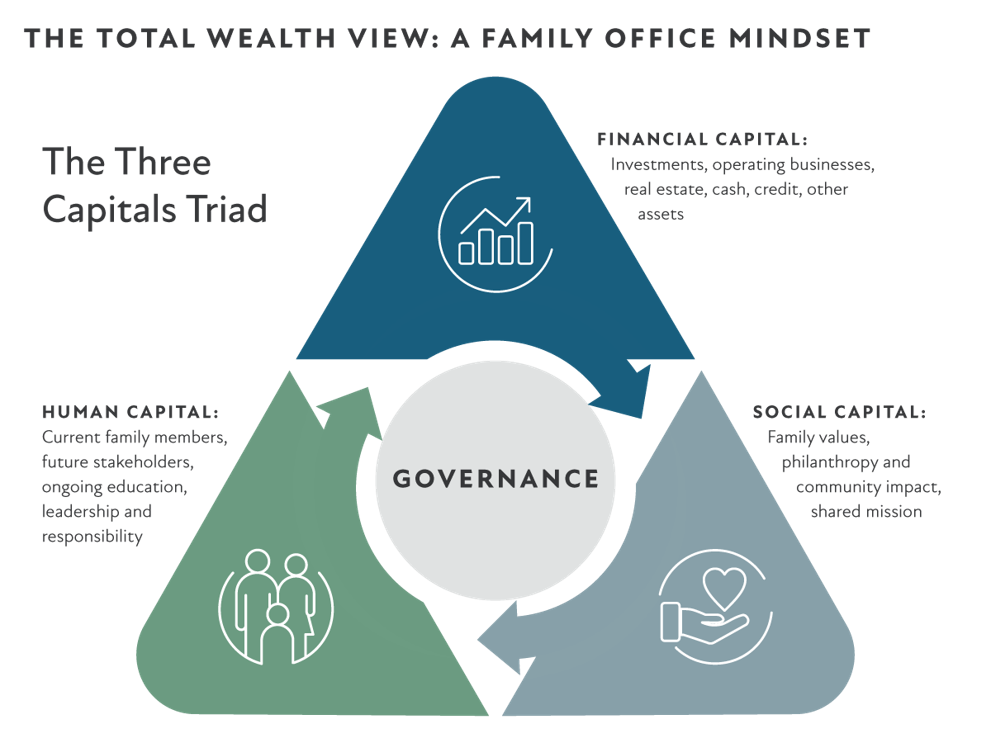
Traditional advisory relationships often focus heavily on the portfolio and touch governance or education only around major events. A family office mindset keeps all three types of capital in view, using governance structures, coordinated planning and ongoing education to support multigenerational wealth.
When those forms of capital aren’t aligned, multigenerational families can struggle to preserve family wealth and maintain family harmony, even if investment performance looks strong on paper. Effective family governance structures — such as a shared family mission statement, a simple family constitution or a recurring family council or assembly — help connect your wealth to your values so that it can support generational wealth and unity over time. You can learn more about these frameworks on Creative Planning’s Family Governance Services for Ultra‑High‑Net‑Worth Families page.
You can apply this mindset through different structures: a dedicated single-family office, a multi-family office or a family office‑style advisory relationship like Creative Planning’s family office wealth management and investment advisory services. The structure matters, but it isn’t the starting point. The real foundation is clarity around what you want your family’s wealth to accomplish and how your family will make decisions together.
Step 1: Understand How Your Family Makes Decisions Today
Before you consider a new structure, it helps to look honestly at how decisions get made right now. Most affluent families fit into one of a few informal patterns:
- Founder‑centric – One person, often a first‑generation wealth creator, makes most major decisions.
- Advisor‑centric – Multiple advisors each handle their own slice, while the family tries to connect the dots.
- Ad‑hoc committee – A small group of family members acts as an unofficial committee without clear roles or processes.
These patterns are shaped by family dynamics, history and often a closely held family business or broader family enterprise. As multiple generations become involved, the lack of a clear governance structure can put both the enterprise and the family’s wealth at risk. Founder‑centric models can struggle without a defined succession plan, advisor‑centric setups can lead to conflicting strategies or tax surprises, and ad‑hoc committees can slow decisions and create confusion if expectations aren’t clear.
A family office mindset encourages you to move from informal habits to explicit answers to questions like:
- Who has the authority to make which decisions?
- How are major decisions communicated?
- What happens if key people are unavailable?
- How will younger family members learn enough to participate effectively?
For help assessing whether your current structure is still serving you, see Your Guide to Family Office Planning.
Step 2: Build a Practical Governance Framework
You don’t need a formal family office to improve family governance. Even simple, documented steps can improve decision‑making and reduce tension, and over time they can evolve into a more formal family governance framework. Key components include the following.
Family values, mission and long‑term vision
Clarify why your wealth exists and what success looks like across generations. Creative Planning’s How to Leave Your Mark: 5 Steps to a Lasting Financial Legacy offers guidance on linking values, mission and legacy.
Defined decision‑making processes
Decide who votes on what, when you require consensus versus majority rule and how deadlocks will be resolved.
Regular family meetings
Schedule recurring meetings to review progress, update priorities and give younger family members a chance to engage. Over time, some wealthy families formalize these gatherings into a family council or larger family assembly.
Roles and responsibilities
Clarify who oversees investments, the family business, philanthropy, communication and administration, and identify backups.
Education for rising generations
Outline how younger family members will learn about investing, governance and leadership, from basic literacy to committee participation.
Creative Planning’s family governance services for ultra‑high‑net‑worth families can help you formalize these elements and integrate them with your estate and wealth transfer plan.
Creative Planning Insight
“In our experience, the families who feel most confident about their future aren’t always the ones with the largest balance sheets. They’re the ones who have taken the time to align their decisions, documents and relationships with a shared vision — whether or not they’ve ever given that effort a ‘family office’ label.” — Jon Davis, JD, Partner
Step 3: Coordinate Your Five Pillars
Once your governance framework is clearer, it’s easier to see where your approach is coordinated and where it’s fragmented. Rather than tracking dozens of tactics, think in terms of five pillars: invest, plan, protect, give and govern.
- Invest – Look at your entire balance sheet (not just marketable securities), including operating businesses and real estate. Ask whether your public and private investments complement one another or unintentionally increase concentration risk across your family assets. Creative Planning’s family office wealth management and investment advisory services and broader private wealth management resources explain how institutional‑grade portfolio construction can support this pillar.
- Plan – Coordinate income, capital gains and gift and estate tax planning, and align your estate documents with your governance model so that they reflect your family’s values and current structure. For deeper guidance, see 7 Considerations for Family Office Tax Structures and The Great Wealth Transfer: Estate Planning Essentials for Affluent Families.
- Protect – Manage risk across entities, insurance and operations, making sure your structures weren’t created piecemeal and that someone regularly reviews coverage and exposures. Creative Planning’s Family Office Risk Management Strategies explores this in more detail.
- Give – Integrate philanthropy into your planning and governance rather than treating it as a separate track, and use giving as a way to involve younger family members in decisions and stewardship of significant wealth.
- Govern – Document your rules and roles, establish how conflicts will be addressed, and clarify how new ideas are evaluated. Your model might eventually include a family council or investment committee like those discussed in Creative Planning’s family governance resources. For communication ideas, Family Communication Tips for a Smooth Generational Wealth Transfer can be a useful companion.
When to Consider a Formal Structure
You may not need a dedicated family office today, but certain signs suggest it’s time to explore a single-family office, multi-family office or family office‑style advisory relationship:
- Multiple operating businesses or complex private investments
- Several branches of the family with differing expectations
- Significant planned or recent liquidity events
- Rapidly expanding administrative demands
- Growing concern about preparing the next generation for leadership roles
For a deeper look at structures, costs and options, visit What Is a Single-Family Office? Structure, Costs and Setup Guide, What Is a Multi-Family Office? Structure, Services and Fees Explained and Your Guide to Family Office Planning. If you prefer coordination without building your own office, Creative Planning’s ultra‑high‑net‑worth wealth management page and our ultra‑affluent family office consultation form can help you explore this path.
Applying the Mindset Without Building an Office
Not every family needs or wants a dedicated family office, but almost every affluent family can benefit from better coordination, stronger governance and more intentional education.
Helpful next steps include writing down your family’s values, mission and long‑term priorities, drafting a simple governance charter that defines who decides what and how, scheduling recurring family meetings focused on both numbers and narrative, mapping your current advisors to identify gaps and overlaps, and asking whether investment, tax, estate, risk and philanthropy decisions are being made in isolation or as part of an integrated plan.
Over time, these steps lay the groundwork for more intentional wealth planning and wealth transfer, which can help protect generational wealth while also supporting healthy family relationships. For many high‑net‑worth families, the right governance framework is what allows significant wealth to move between generations without creating unnecessary family conflict.
If you’d like help applying this mindset to your situation, Creative Planning’s family office‑style advisory teams can work with you to evaluate your governance framework, identify coordination gaps and design a plan that reflects your family’s goals, complexity and preferences — with or without a formal office structure. You can learn more or request a conversation through the family office wealth management and investment advisory services page or the ultra‑affluent family office consultation form.
