



Taxes can create a major performance drag on any investment portfolio. However, they’re especially costly if you have concentrated equity exposure in your portfolio or are facing a large upcoming taxable event, such as a business sale. Fortunately, there are steps you can take to reduce your tax exposure in these scenarios. One such strategy is referred to as enhanced direct indexing.
Key Takeaways
- Direct indexing involves purchasing some or all of the individual securities that make up a benchmark index to try to replicate its performance.
- Direct indexing allows for more customization and tax efficiency than purchasing shares of an index tracking an ETF or a mutual fund.
- Enhanced direct indexing adds a long-short strategy overlay to improve tax efficiency and potentially generate excess returns.
- Enhanced direct indexing is generally only recommended for high-net-worth investors with $1 million or more in taxable investment assets due to the complexity, associated costs and additional risks. Custodians may require higher account minimums.
What Is Direct Indexing?
Before we get into the “enhanced” part of this strategy, let’s define direct indexing. Direct indexing involves directly purchasing many or all of the individual securities that make up a benchmark index, such as the Dow Jones Industrial Average or the S&P 500 Index. The goal is to replicate the index’s performance while giving investors more control over their portfolios.
In contrast, when investing in a traditional ETF or mutual fund, you buy shares of a fund that holds the same securities in the same proportions as the benchmark index it tracks. You don’t directly own the securities in the latter case, and you can’t control which securities are held by the mutual fund or ETF.
With direct indexing, you can reap the following key benefits:
- Avoidance of additional concentration – Direct indexing allows investors with highly concentrated stock positions to avoid buying more of that position. For example, if you work at Procter & Gamble (P&G) and have a significant amount of P&G stock in your employer-sponsored retirement plan, you probably don’t want to purchase additional P&G shares by investing in an overall index. Direct indexing allows you to select a subset of individual stocks that doesn’t include P&G. Investors dealing with this type of exposure can learn more in Managing Concentrated Stock Positions.
- Tax-loss harvesting – Direct indexing provides an opportunity to generate additional tax efficiencies through tax-loss harvesting. This involves selling an investment that has declined in value in the short term and replacing it with a highly correlated alternative. Take the S&P 500, for example. While it has historically shown returns of approximately 8%-9% per year, an average of 150 of the stocks in the index — a full 30% of the index — lose 10% or more in value in any given year. With the individual ownership structure of direct indexing, you can systematically harvest these capital losses. For a deeper explainer, see Help Maximize Your Savings With Tax-Loss Harvesting.
For readers who want a broader look at how this approach can help diversify concentrated equity, see Direct Indexing: A Tax-Efficient Strategy for Diversifying Concentrated Holdings.
What Is Enhanced Direct Indexing?
Enhanced direct indexing is an advanced wealth management strategy that builds on direct indexing by adding a systematic long-short investment overlay. In addition to replicating a benchmark index, enhanced direct indexing establishes long positions in securities expected to outperform and short positions in those expected to underperform.
Together, the core portfolio and overlay are designed to maintain approximately the same net market exposure as the target benchmark while seeking alpha, or returns in excess of the benchmark. The long-short overlay also creates additional opportunities to harvest capital losses, potentially improving after-tax returns.
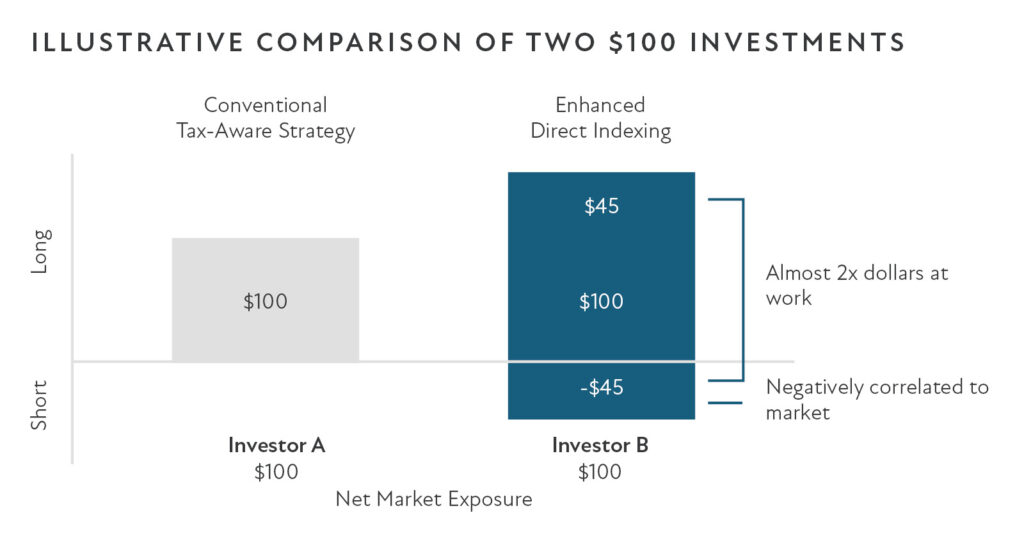
Let’s consider an example to illustrate how enhanced direct indexing works.
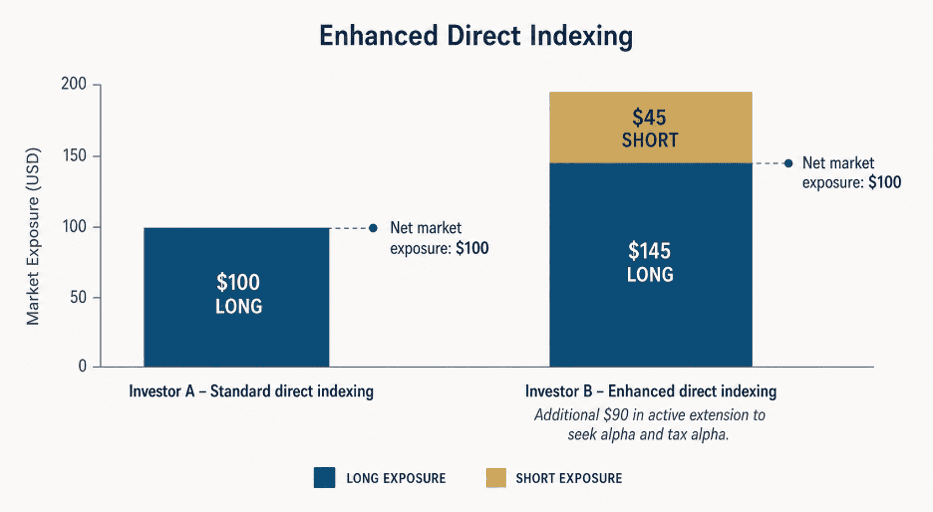
Investor A invests $100 using a standard direct indexing approach. This equals $100 of net market exposure that fluctuates according to the movement of the underlying investments.
Using an enhanced approach, Investor B takes both a long and a short position alongside the $100 investment, resulting in $145 long and $45 short. Doing so provides the investor with $100 of net market exposure and $90 of active extensions. Investor B has the same net market exposure as Investor A but with the benefit of additional dollars at work in pursuit of excess returns and potential capital losses, or tax benefits. Because the enhanced approach has both long and short exposure, Investor B can create opportunities to realize losses whether the market goes up or down.
Overall, when compared to other tax-aware equity strategies, enhanced direct indexing has the potential to offer larger and more consistent after-tax returns for certain investors.
Direct Indexing vs. Enhanced Direct Indexing
Direct indexing and its enhanced counterpart share the same foundation. Investors purchase some or all of the individual stocks comprising a benchmark index rather than purchasing shares of a traditional index fund. However, enhanced direct indexing takes it a step further by adding a long-short overlay to seek alpha and improve tax efficiency.
When it comes to tax-loss harvesting, standard direct indexing only allows for capital losses on long positions. You can sell declining stocks to realize losses and then replace them with similar securities to maintain market exposure. Enhanced direct indexing, on the other hand, creates opportunities to realize capital losses on both long and short positions. So when short positions move against the portfolio, these losses can also be realized. In addition, enhanced direct indexing uses leverage, which expands the number and size of positions, creating more opportunities for tax-loss harvesting.
These differences make enhanced direct indexing far more complex and expensive than direct indexing. Upgrading requires converting a standard cash separately managed account (SMA) into a margin account. Additionally, sophisticated software is required to simultaneously manage hundreds of long and short positions while balancing elements such as benchmark alignment, leverage, margin thresholds, financing and borrowing costs, alpha exposure, tracking error, and tax considerations in real time.
Due to its costs, complexity and risk, enhanced direct indexing is generally best suited for high-net-worth investors with at least $1 million in taxable investment assets who are facing one or both of the following situations:
- A large taxable event – This could be a business sale, an inherited retirement account distribution, a deferred compensation payout or another major taxable event expected to create a significant tax liability.
- A highly concentrated stock position – This is when a large portion of one’s wealth is tied to a single stock, and they want to unwind the holding in a tax-efficient manner. Readers navigating this issue may also find value in Managing Concentrated Stock Positions and The Double-Edged Sword of Concentrated Holdings.
Overall, enhanced direct indexing can provide meaningful tax benefits for certain high-net-worth investors. Capital losses can not only offset gains in the current tax year but also be carried forward to help offset gains from forecasted liquidity events. However, enhanced direct indexing comes with high operational costs and structural risks that can make it detrimental for lower-net-worth investors. If you’re considering this tax planning approach, it’s important you discuss it with your wealth manager to see if it’s the right fit.
Direct Indexing and Enhanced Direct Indexing Compared
Creative Planning Insight
“Enhanced direct indexing can be a powerful tool for investors with complex tax situations, but it’s not a shortcut to outperformance. The real value often shows up in what you keep after taxes, not just what the market returns.” — Chris Rowell, Managing Director, Partner
Is Enhanced Direct Indexing Right for You?
Frequently Asked Questions About Enhanced Direct Indexing
What are the risks of enhanced direct indexing?
Enhanced direct indexing carries various risks, including high costs that can outweigh your returns and tax savings, short sale risk, portfolio lock-in over time, accidental wash-sale rule violations across accounts, and additional tax complexity.
What are the benefits of enhanced direct indexing?
The main benefits of enhanced direct indexing include the potential for higher returns and greater tax-loss harvesting opportunities across the full market cycle. It also offers a way to systematically unwind large, highly concentrated stock positions without triggering massive capital gains all at once.
Who should consider enhanced direct indexing?
Enhanced direct indexing is generally best suited for high-net-worth investors with more than $1 million in taxable assets who have large capital gains to offset or concentrated stock positions. However, there are high costs and risks involved, so the decision should be reviewed with a trusted financial advisor well-versed in the strategy.
