



Estimated reading time: 9 minutes
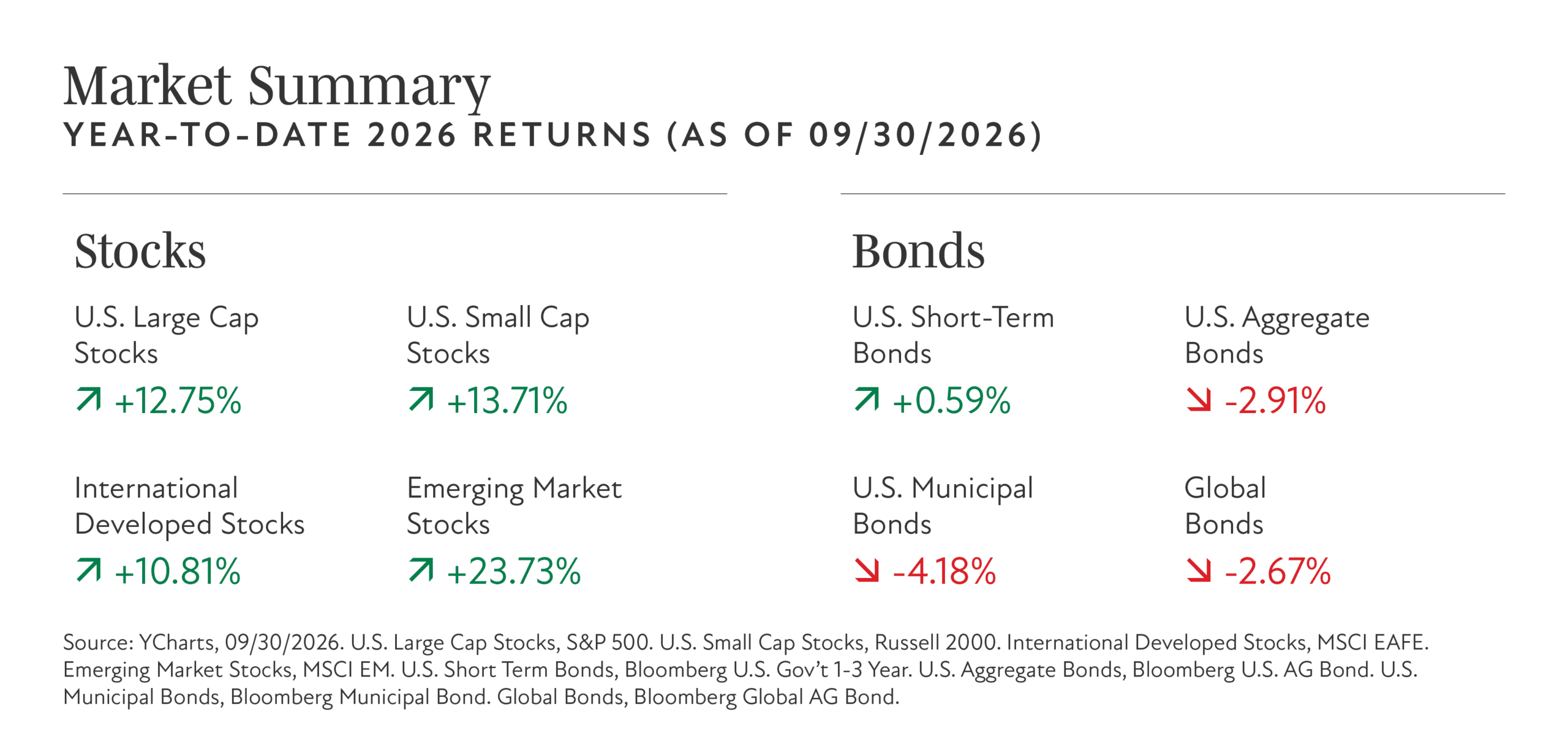
This image shows year-to-date 2026 returns as of 9/30/2026. U.S. large-cap stocks are up 12.75%. U.S. small-cap stocks are up 13.71%. International developed stocks are up 10.81%. Emerging market stocks are up 23.73%. U.S. short-term bonds are up 0.59%. U.S. aggregate bonds are down 2.91%. U.S. municipal bonds are down 4.18%. Global bonds are down 2.67%.
As fall settles into the Northern Hemisphere, the changing colors outside provide a seasonal reminder of what markets often do as well.
If you’re only going to read a sentence or two of this commentary, as my wife does,1 here’s the key takeaway:
Over the long run, investors are rewarded more for being owners than for being lenders.
In plain English, buying stocks has historically been more rewarding than buying bonds or keeping funds parked in cash. The price of admission for these long-term returns is volatility. And volatility can occasionally be severe. Investors who owned stocks during the technology bubble collapse endured a decline lasting more than 1,000 days between 2000 and 2002.2 These periods are painful in the moment. They’re also the reason the long-term rewards exist in the first place.
The short-term return numbers at the top of the page support this conclusion. The problem is that short-term returns can be misleading. In fact, they’re misleading roughly 25% of the time. As shown below, nearly a century of market history — spanning wars, depressions, inflation spikes, deflation, booms, busts, political turmoil, pandemics, technological revolutions and moments when everyone was sure “this time is different” — is far more persuasive than any one-year period.
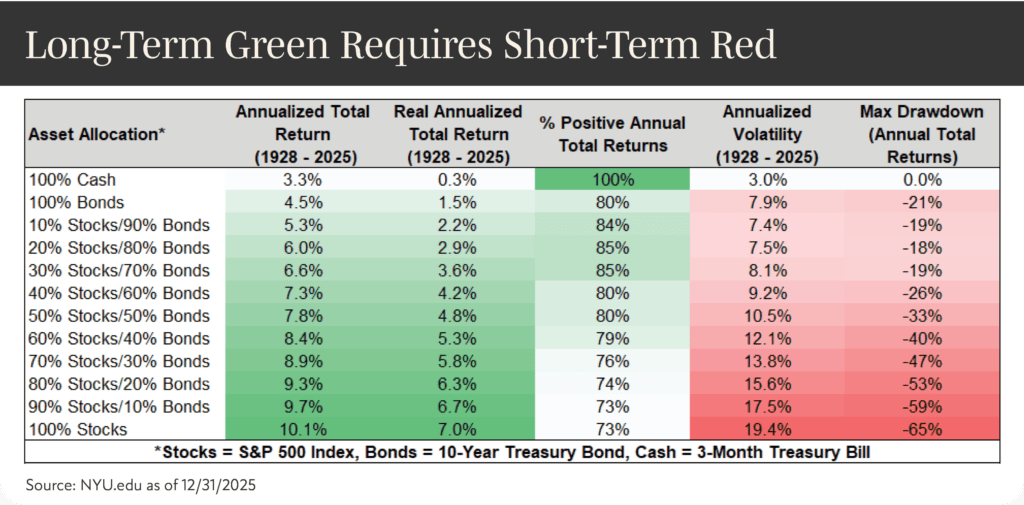
This table examines portfolios consisting of 100% cash, 100% bonds, 100% stocks, and all stock/bond splits in 10% increments (90%/10%, 80%/20%, etc.). It then shows the annualized total return (1928-2026), real annualized total return (1928-2026) and % positive annual total returns for each. It also shows annualized volatility (1928-2026) and max drawdown (annual total returns) for each. Overall, return and volatility both climb consistently with more stocks in your portfolio.
1On November 6, my wife will have legally put up with me for 20 years. Thanks, pumpkin.
2We’re concerned that it’s been a long time since investors have had to endure a sustained multiyear market decline. Longevity increases the likelihood of jumping off the roller coaster at the wrong time but actually requires holding on that much tighter. An entire generation of seasoned leaders and investors hasn’t had to endure this pain.
One of Wall Street’s most punishing and persistent myths is that retirement planning can be reduced to a simple formula, such as “100 minus your age in stocks.” The math sounds elegant. The problem is that we don’t live elegant, formulaic lives. Retirement allocations should be driven by one’s spending needs, income sources and time horizon, not one’s birthday.
Another Wall Street myth resurfaced this year in the bond market.
No matter how intelligent you sound, how expensive your suit is or how many letters follow your name, human beings are remarkably poor at forecasting the future.3
At the beginning of 2026, the overwhelming Wall Street consensus was that interest rates would decline throughout the year. Instead, the Federal Reserve officially raised rates for the first time in three years.
This isn’t unusual.
The surprise isn’t that forecasters were wrong. The surprise is that investors continue making decisions as if these forecasts are reliable.
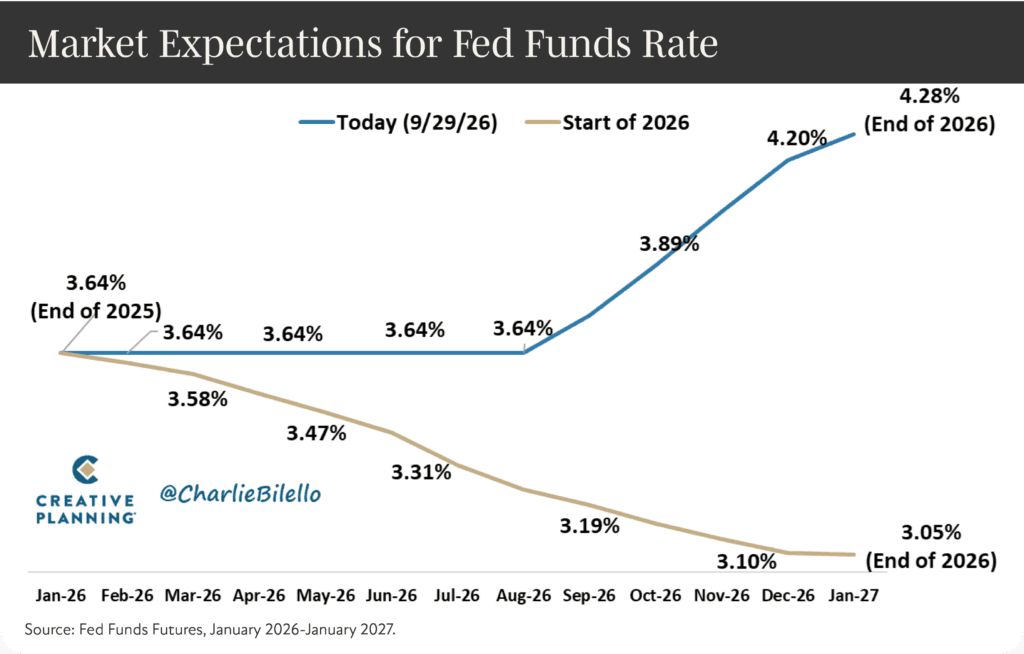
This chart shows market expectations for what the Fed funds rate will be at the end of 2026 and how much today’s expectations differ from those at the beginning of 2026. At the beginning of 2026, the market expected interest rates would be 3.05% by year-end. Today, the market expects interest rates to be 4.28% by year-end.
3The percentage of active money managers that underperform their benchmarks just increased to 95%. You’re twice as likely to be born left-handed (10%) as you are to outperform the market, so if you find a left-handed market clairvoyant, you’ve really found a gem.
Despite all the headlines surrounding inflation, geopolitics and economic uncertainty, 2026 has actually been a remarkably calm year by historical standards.4 This is yet another example of how headlines and market outcomes often have very little in common.
Focus on What You Can Control
The lesson isn’t simply that stocks outperform bonds over time. The larger lesson is that investors consistently hurt themselves when they attempt to predict what comes next instead of preparing for a wide range of possible outcomes.
This is precisely why your portfolio must be designed to be resilient rather than dependent on a single forecast being correct.
Our service offering can largely be summarized as follows.
Spend absolutely no time worrying about what you can’t control, such as short-term market movements, and spend all your time focusing on what you can control.
◊ You can’t control inflation.
◊ You can’t control interest rates.
◊ You can’t control elections.5
◊ You can’t control recessions.
◊ You can’t control your teenager’s listening skills.
◊ You can control your tax exposure.
◊ You can control your estate planning.
◊ You can control how much you spend.
◊ You can control how much you save.
◊ You can control how your portfolio is structured.
History suggests that investors are far better served by focusing on things within their control than by attempting to predict the Federal Reserve’s next move.
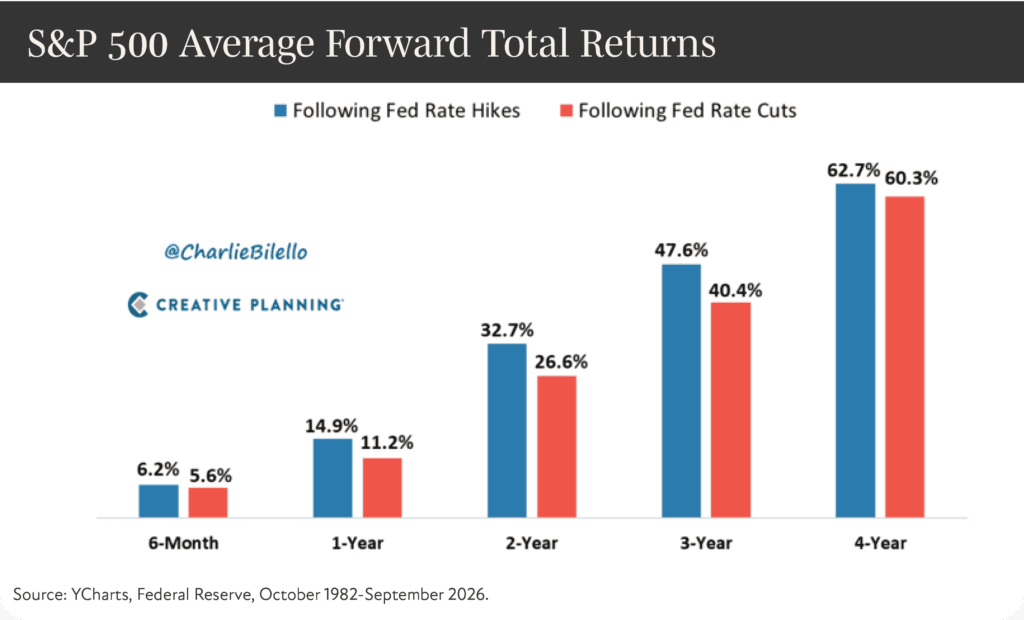
This charts shows S&P 500 average forward total returns in 6-month, 1-year, 2-year, 3-year and 4-year increments from October 1982 through September 2026. For each, returns are lower following Fed rate cuts than they are following Fed rate hikes.
4Even though markets average annual returns of about 10% over the long run, in any given year the market declines an average of around 14% at some point. Volatility is the norm, not the exception.
5Midterm elections are coming up, and may your dog in the fight win but your financial plan stay unchanged, as elections are completely unactionable from an investment standpoint. No offense to dogs — I have two of them, and I think they’re both independents.
While it may feel counterintuitive,6 historical data actually shows that stocks have generally performed better during periods of rising interest rates (as shown in the chart above). More importantly, the data reinforces a simple but powerful lesson:
Stay invested — regardless of what interest rates are doing today, tomorrow or next quarter.
As we barrel toward the end of 2026, below are a few often-overlooked opportunities worth considering. Think of it like Cinderella. When the clock strikes midnight on December 31, these opportunities will disappear as quickly as Cinderella’s pumpkin carriage.
Don’t pass on the closest thing to free money
If you’re still working and participating in a retirement plan, such as a 401(k) or 403(b), make sure you’re capturing every available dollar of employer matching contributions.
If you contribute 3% and your employer matches 3%, that’s effectively a guaranteed 100% return on your contribution.7
And retirees can help family members unlock these benefits. If a child or grandchild can’t afford to contribute enough to receive the full employer match, a gift from you may allow them to increase their retirement contributions while maintaining their lifestyle. Those increased contributions, in turn, unlock the potential for immediate tax advantages, matching contributions and additional years of compounding.
That’s about as close to a triple win as investing gets.
Put assets in the right buckets
Successful investing isn’t just about choosing investments. It’s also about choosing where those investments live.
Should assets be in a Roth IRA?
In a traditional 401(k)?
In a health savings account (which can often be the most tax-efficient investment account available)?
In an education account?
In a trust?
In a taxable account?
The long-term benefits of proper account placement can be enormous, and unlike future market returns, this is something completely within your control.
Don’t assume tax obligations are fixed
If you’ve experienced a significant taxable event this year, such as selling a business, real estate or a concentrated stock position, there’s still time to evaluate planning opportunities.
Waiting until December and assuming that’s the only time tax planning matters limits your options considerably to only one month out of an entire year.
Keep Uncertainty in Perspective
The opportunities noted above are far from exhaustive because everyone’s circumstances are different. We’re happy to discuss any of these opportunities — or others — as they relate to your specific situation.
The future will remain uncertain, as it always has been.
Fortunately, successful investing has never required certainty.
Focus on the variables you can control. Let historical data and your unique circumstances guide your decisions. And remember that while you can’t prevent the leaves from turning red, you can take steps to keep your financial decisions in the green.
6The other counterintuitive fact I didn’t believe at first is that investing at all-time market highs actually leads to better returns over the long term compared to investing at any other time. Should you practice that? No. The point is to keep investing.
7Focus on what’s guaranteed, or close to guaranteed, and important to add value. Then let the other stuff go. I can’t guarantee my wife puts up with me for another 20 years, but I sure hope she will — and for a whole lot longer. As Winnie the Pooh says, “If you live to be a hundred, I want to live to be a hundred minus one day so I never have to live without you.” Now, I completely understand the eye-rolling. But you’ve seen my mugshot. If you saw my wife’s, you’d quickly conclude that my greatest planning success has nothing to do with investments and everything to do with convincing her to keep me around this long.
