



Key Takeaways
- Wealth management for high-net-worth individuals coordinates investments, tax planning, estate strategies, risk management and family goals into one cohesive plan instead of relying on a series of disconnected decisions.
- HNW individuals often face complex planning needs involving concentrated positions, equity compensation, business ownership, multistate tax exposure and multigenerational wealth transfer considerations.
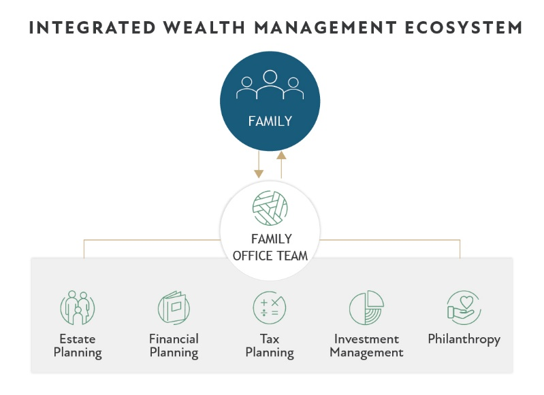
- Family office-style advisory services help centralize investment, tax, estate, and risk management so that families aren’t left managing a patchwork of independent professionals on their own.
- The thoughtful use of trusts, diversified investment strategies and coordinated tax planning helps preserve built capital, maximize after-tax outcomes and support smoother transitions across generations.
- Proactively managing concentration, liquidity, liability and longevity risk as part of a coordinated financial strategy helps to protect your net worth while funding your lifestyle and legacy goals.
Introduction to Wealth Management for High-Net-Worth Individuals
If your financial life has grown more complex over time, you’ve probably realized that managing money and managing wealth are two very different things. Wealth management for high-net-worth individuals means coordinating investment management, tax planning, estate strategies, risk management and family goals into one integrated plan rather than making a series of disconnected decisions.
This article is designed for high-net-worth individuals and affluent families. It explores advanced wealth management strategies tailored to complex balance sheets and multigenerational goals, with a focus on practical ways to preserve wealth, pursue growth and manage risk over the long term. You’ll see how a coordinated, planning-led approach can help you simplify decisions, avoid costly missteps and feel more confident about your financial future.
By the end, you’ll better understand what defines a high-net-worth individual, how a family office-style team can support your needs, how trusts and estates preserve wealth, and which investment and risk management strategies may help you protect and grow your net worth. You’ll also find clear next steps to move from theory to action.
Understanding High-Net-Worth Individuals
High-net-worth individuals (HNWIs) are typically defined as those with at least $2.7 million in assets, excluding their primary residence. Ultra-high-net-worth (UHNW) families often hold $30 million or more in investable assets, with complex portfolios that blend operating businesses, private investments, and multistate or global exposure. What truly defines this group isn’t just the size of their net worth but the structural complexity that comes with it.
Many high-net-worth households manage multiple businesses, trusts, properties and investment accounts alongside competing family, philanthropic and lifestyle priorities. Their financial planning often spans concentrated equity positions, equity compensation, cross-border or multistate tax issues, and multigenerational wealth transfer decisions. As a result, the stakes of each decision are higher, and the impact of misalignment between investments, taxes, estate planning and risk management can be significant.
Compared with general investors, high-net-worth individuals spend less time on basic accumulation and more time defending existing wealth from tax drag, market volatility, legal exposure and the risk of family conflict. They may also have access to institutional-caliber investment strategies and private wealth management services that aren’t typically available to the broader public. This combination of complexity and opportunity is why tailored financial planning and specialized wealth management for high-net-worth individuals is so important.
How Comprehensive Wealth Management Addresses HNWI Needs
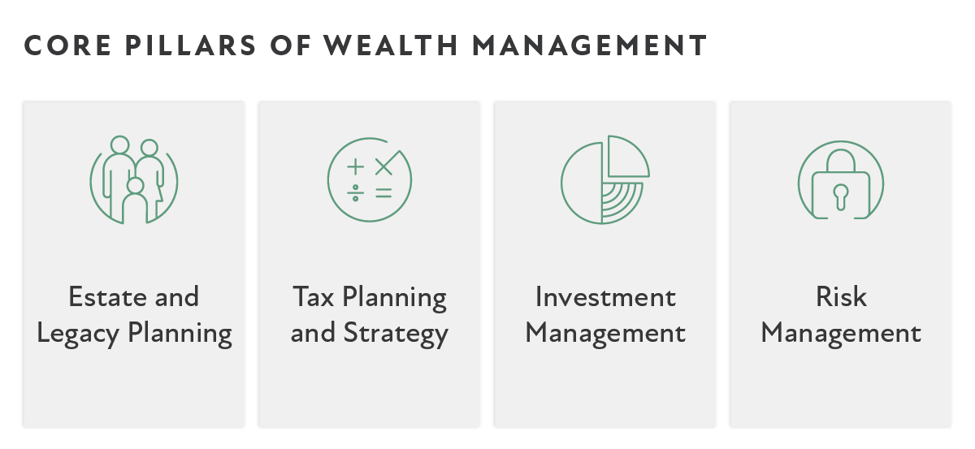
For high-net-worth individuals and families, wealth management goes far beyond portfolio construction. It looks at the entire financial landscape and asks whether each decision strengthens or weakens the overall plan. Instead of treating your financial life as a collection of accounts, a comprehensive approach coordinates investment management, tax planning, estate planning and risk management around your specific financial goals.
An effective framework usually includes three core components. First, a dedicated wealth manager or wealth advisor who serves as a central coordinator, helping you prioritize objectives and acting as a single point of contact across your financial life. Second, a tailored financial plan that unifies advice from your financial advisor, CPA, estate planning attorney and other professionals so that you’re not left acting as the middleman. Third, an integrated execution model — sometimes described as a comprehensive wealth ecosystem — that synchronizes your asset allocation, tax liabilities and legal protections as your life evolves.
For example, a large concentrated stock position affects more than just your investment strategy; it also influences your estate tax exposure, liquidity plan and annual income tax brackets. A business sale or major liquidity event isn’t only about maximizing price; it requires synchronized execution between tax planning, charitable giving, trust funding and new investment strategies. Treating each of these decisions in isolation can increase risk and reduce after-tax outcomes, while an integrated wealth management strategy helps them work together.
Family Office Services and Their Role
As net worth grows, the time, energy and technical expertise required to manage wealth expand right along with it. Traditional family office structures emerged to address this challenge, offering dedicated resources to coordinate investments, tax planning, estate planning and administrative needs for ultra-high-net-worth households.
A single-family office is built to serve one multigenerational family and typically offers maximum control but also requires significant ongoing overhead, staffing and management. A multi-family office, by contrast, uses shared infrastructure to support several distinct families, distributing costs while still providing highly personalized private wealth management services. In either model, the goal is similar: to centralize decisions, reduce fragmentation, and proactively manage complex balance sheets.
For many high-net-worth families, building a standalone family office can be impractical or inefficient. Instead, they seek an institutional alternative — a way to “plug into” an existing team of specialists without taking on the burden of hiring and managing separate CPAs, attorneys and investment professionals. Firms such as Creative Planning provide this type of planning-led, multidisciplinary support, integrating high-net-worth wealth management with in-house tax, estate planning and risk management expertise under one roof. This model allows clients to capture many of the benefits of a family office — coordinated advice, sophisticated strategies and a centralized relationship — without needing to run an independent firm themselves.
You might explore more on family office services and how they support ultra-affluent families by reviewing resources like Creative Planning’s family office services and ultra-high-net-worth wealth management pages.
Trusts and Estates for Wealth Preservation
For a high-net-worth individual, comprehensive estate planning is rarely just a stack of legal documents; it’s the road map for how your wealth will support the people and causes you care about long after you’re gone. Trusts and estates are central tools in this process, functioning as the legal and structural backbone of your legacy plan.
Trusts serve several purposes at once. By placing assets into appropriately structured trusts, families can safeguard capital from litigation, creditor claims and potential marital disputes while clearly defining how and when beneficiaries receive funds. Revocable living trusts can streamline the management of assets during your lifetime and help your estate avoid the delays and publicity of probate. Irrevocable trusts, including structures like spousal lifetime access trusts (SLATs), grantor retained annuity trusts (GRATs) and intentionally defective grantor trusts (IDGTs), can remove appreciating assets from your taxable estate and support multigenerational wealth transfer.
Charitable trusts, such as charitable remainder trusts (CRTs) and charitable lead trusts (CLTs), can be used to align philanthropic goals with tax planning and income needs. Thoughtful use of these vehicles helps you reduce estate and income tax exposure, preserve more wealth for future generations and ensure your assets are managed according to your values. The most effective estate planning strategies are highly personalized and coordinated with your broader wealth management plan, including your investment strategy, business interests and philanthropic vision.
A key best practice is to avoid letting your estate plan sit in a silo. If your investment accounts aren’t titled in alignment with your trusts, or if beneficiary designations on retirement accounts and insurance policies are out of date, your plan may not work as intended. Coordinating your estate planning with your tax and investment strategies can minimize surprises, reduce multi-generational estate tax exposure and support smoother transitions across generations.
Investment Strategies and Portfolio Diversification
Developing investment strategies for high-net-worth individuals requires moving beyond standard retail portfolios. At this level, investment management must integrate with cash flow needs, tax planning, entity structures and long-term family goals. The objective isn’t just to pursue return; it’s to pursue risk-aware, tax-smart returns that support the rest of your wealth management strategy.
Effective investment strategies start with a clear understanding of your financial goals, risk tolerance and time horizon, as well as your broader net worth and liquidity profile. High-net-worth families may allocate across public equities, fixed income, real assets and alternative investments, such as private equity, private credit or venture capital. They might also hold luxury or passion assets, such as fine art or collectibles, where the financial and emotional considerations are tightly linked. Each of these asset classes introduces different risk, return and liquidity characteristics that need to be mapped carefully to near-term spending, long-term growth and legacy priorities.
Portfolio diversification is especially important when significant wealth has been built through a single core asset, such as a closely held business, a concentrated stock position or a real estate portfolio. Concentration often builds wealth, but diversification is what helps preserve it. High-net-worth individuals can manage this transition through staged sales, tax-aware rebalancing, options-based strategies or the use of exchange funds and other sophisticated techniques that reduce risk without triggering unnecessary tax bills all at once. Customizing your investment strategy at this level often benefits from a team that understands both institutional investing and the personal implications of large, complex positions.
Customized Risk Management Solutions
For affluent families, risk management extends far beyond market volatility. A comprehensive risk strategy takes an enterprise-level view of your financial and personal life, recognizing that legal exposure, governance challenges and health-related risks can be just as significant as investment losses.
Key risk dimensions for high-net-worth individuals include portfolio risk, concentration risk and liquidity risk, which cover how your investments might behave under stress and how easily you can access capital when needed. Liability risk is another major factor, especially for individuals serving on corporate boards, operating professional practices or maintaining a high public profile. Governance risk arises when there are unclear succession plans for family businesses, ill-defined trustee responsibilities or unresolved family dynamics around control and decision-making. Longevity and health risks further complicate planning, particularly as people live longer and face more complex healthcare and long-term care needs.
Customized risk management solutions typically begin with a thorough diagnostic review of your existing protection measures (e.g., insurance policies, legal entities and governance structures) to determine whether they still match your current net worth and lifestyle. From there, you might refine legal entity structures such as limited liability companies (LLCs) or family limited partnerships (FLPs) to separate personal and business assets and strengthen asset protection. Families often formalize governance frameworks through shareholder agreements, family charters or regular family meetings that clarify roles and decision-making processes.
Health and longevity planning may include coordinating Medicare and supplemental coverage, long-term care strategies and funding mechanisms in a way that aligns with your overall cash flow and estate plan. The goal is to build a risk management framework that supports your wealth rather than relying on ad hoc coverage that leaves gaps.
Tax Planning as a Continuous Process
For high-net-worth individuals, tax planning isn’t a once-a-year activity but rather an ongoing part of wealth management. Because taxes can significantly erode returns and limit flexibility, effective tax planning is about more than deductions; it’s about structuring your entire financial life to minimize drag and expand your options.
Advanced tax planning for high-net-worth families often includes asset location strategies where tax-inefficient assets, like income-heavy or high-turnover investments, are held in tax-deferred or tax-advantaged accounts while tax-efficient assets remain in taxable accounts. High-net-worth investors may also use enhanced direct indexing to replicate broad market exposure while harvesting losses from individual securities, which can offset current or future capital gains. For those approaching or in retirement, thoughtful Roth conversion strategies during lower-income years can help reduce future required minimum distributions and create more tax-exempt income later in life.
Multistate and international tax considerations add another layer of complexity. Where you live, where your businesses operate and where your real estate and investments are located can all affect your overall tax burden. Coordinating residency decisions, business structures and real estate ownership with your broader wealth management strategy can help you maintain compliance while reducing unnecessary state and local tax exposure.
The most effective tax planning happens when your financial advisor, CPA and estate planning attorney work in concert rather than in isolation. This type of integrated planning is a hallmark of planning-led firms like Creative Planning, which combines high-net-worth financial planning with in-house tax and estate specialists so that decisions are made with your full picture in mind.
Putting Strategies Into Practice
Bringing order to a complex financial life means shifting from reactive, one-off decisions to a unified long-term approach. For many high-net-worth individuals, the first step is simply creating clarity.
Start by defining your most important financial goals, including family, business and philanthropic objectives, over the next ten years and beyond. Then assemble a master inventory of your accounts, entities, trusts, ownership interests and key documents so that you can see your complete financial picture in one place. Once you have that, evaluate how your current advisors operate. Are your financial advisor, CPA and estate attorney actively collaborating, or are you left coordinating separate recommendations that don’t always align?
Creative Planning Insight
“True wealth management isn’t about chasing the highest return; it’s about building a coordinated plan that protects what you’ve already built, supports the life you want today and preserves your legacy for the next generation.” — Carlos Lopez, Managing Director, National Wealth Manager
Next Steps
High-net-worth individuals face a unique combination of complexity, opportunity and responsibility. Coordinated wealth management — grounded in integrated financial planning, family office-style support, thoughtful use of trusts and estate strategies, advanced investment and diversification techniques, customized risk management, and continuous tax planning — can help you navigate this complexity with more clarity and confidence.
