



Running a business takes everything you’ve got. Between managing operations, employees, customers and growth, it’s easy to let financial planning slide to the bottom of your to-do list. But the business owners who build real, lasting wealth aren’t necessarily the ones who work the hardest. They’re the ones who plan the smartest.
Whether you’re launching a startup, scaling an established company, or starting to think about what comes next, a solid financial plan might be the single most important tool you have.
Key Takeaways
- Financial planning isn’t just about today — it connects your business decisions to your long-term personal wealth.
- Cash flow, not just profit, determines whether your business survives and grows.
- Tax planning done early can significantly change how much wealth you actually keep.
- Retirement planning and exit planning go hand in hand — and both need to start sooner than you think.
- The right advisors and tools can transform your finances from reactive to strategic.
Why Financial Planning Matters for Business Owners
Most business owners pour everything into their company, creating a situation most investors never have to deal with: the majority of your net worth tied up in a single, illiquid asset — your business. Yet standard financial planning advice rarely accounts for this reality.
Financial planning for business owners looks different from what most financial content describes. It’s not just about budgeting or picking a retirement account. It’s about connecting your business finances to your personal finances in a coordinated way so that every major decision — from hiring and compensation structure to whether to take on debt — is made with your long-term goals in mind.
Without this connection, you’re essentially flying two planes at once without looking at the same dashboard, which is where most business owners run into trouble.
Common challenges business owners face include:
- Concentrated risk — your wealth depends on one asset (the business)
- Inconsistent cash flow, making it tough to plan ahead
- Complex, constantly changing tax obligations
- No retirement plan separate from the business itself
- No clear succession or exit strategy
Key Components of a Robust Financial Plan
A strong financial plan covers both sides of the ledger — business and personal — and addresses what’s happening today as well as what you want to happen years from now.
Budgeting and expense management
A budget isn’t just a spreadsheet — it’s your decision-making framework. It tells you what you can afford to hire for, invest in or cut, and it’s the foundation everything else is built on. Start by documenting all business expenses (fixed and variable) and estimating monthly income, then compare the two. Update numbers regularly as your business changes.
One of the most common mistakes small business owners make is either not having a budget at all or failing to stick to one. Without a budget, you can’t plan for taxes, insurance or emergencies — and you’ll likely accumulate unnecessary debt.
Cash flow management
Profit and cash flow aren’t the same thing, and this distinction matters enormously. A business can show strong profits on its income statement while having dangerously low cash on hand, because profit might be tied up in unpaid invoices or slow-moving inventory.
Understanding your cash flow statement is critical. It shows where cash is actually coming from and going to across three categories: operating activities (day-to-day business), investing activities (assets purchased or sold) and financing activities (debt and equity). A strategic finance function uses this data in real time — not just retroactively — to forecast, plan and help you make smarter decisions.
Consider these practical cash flow tips:
- Create and regularly review a 90-day cash flow projection
- Actively manage outstanding invoices
- Build an emergency fund for unexpected slowdowns
- Work with an accountant to identify gaps before they become crises
Risk management and insurance
Business ownership comes with risks most employees never face. What happens if a key employee leaves unexpectedly? What about a lawsuit, a cyberattack or a natural disaster? A thorough risk assessment should evaluate your exposure across property and casualty, life, disability, and liability coverage — for both your business and your household.
If you have a business partner, a buy-sell agreement is essential. This legally binding document specifies how ownership interests transfer if a partner dies, becomes disabled, retires or exits. Without one, you’re leaving your business — and your partners — unnecessarily exposed.
Tax planning
Tax planning for business owners is one of the most complex areas of financial management — and one of the highest-leverage ones. The structure of your business, how you pay yourself, when you recognize income and expenses, and how you handle retirement contributions all affect your tax bill significantly. Small decisions made early in the year — or even years earlier — can result in meaningfully different outcomes at tax time. A qualified accountant who specializes in business taxation isn’t optional at this level. It’s one of the smartest investments you can make.
Creative Planning Insight
“Business owners face a unique challenge that most investors don’t — the majority of their wealth is concentrated in a single illiquid asset. The goal of integrated financial planning is to connect every business decision (compensation, reinvestment, exit timing, etc.) to a broader picture of what the owner actually wants their life to look like after the business.” – Drew Howell, CFP®, Managing Director
Investment Strategies for Entrepreneurs and Startups
One of the biggest financial risks business owners face is over-concentration. If most of your net worth is in your business, any financial setback — a bad quarter, a market downturn, a key client walking away — hits your personal wealth directly. Diversification isn’t just a portfolio concept; for business owners, it’s a survival strategy.
How to think about investing as a business owner:
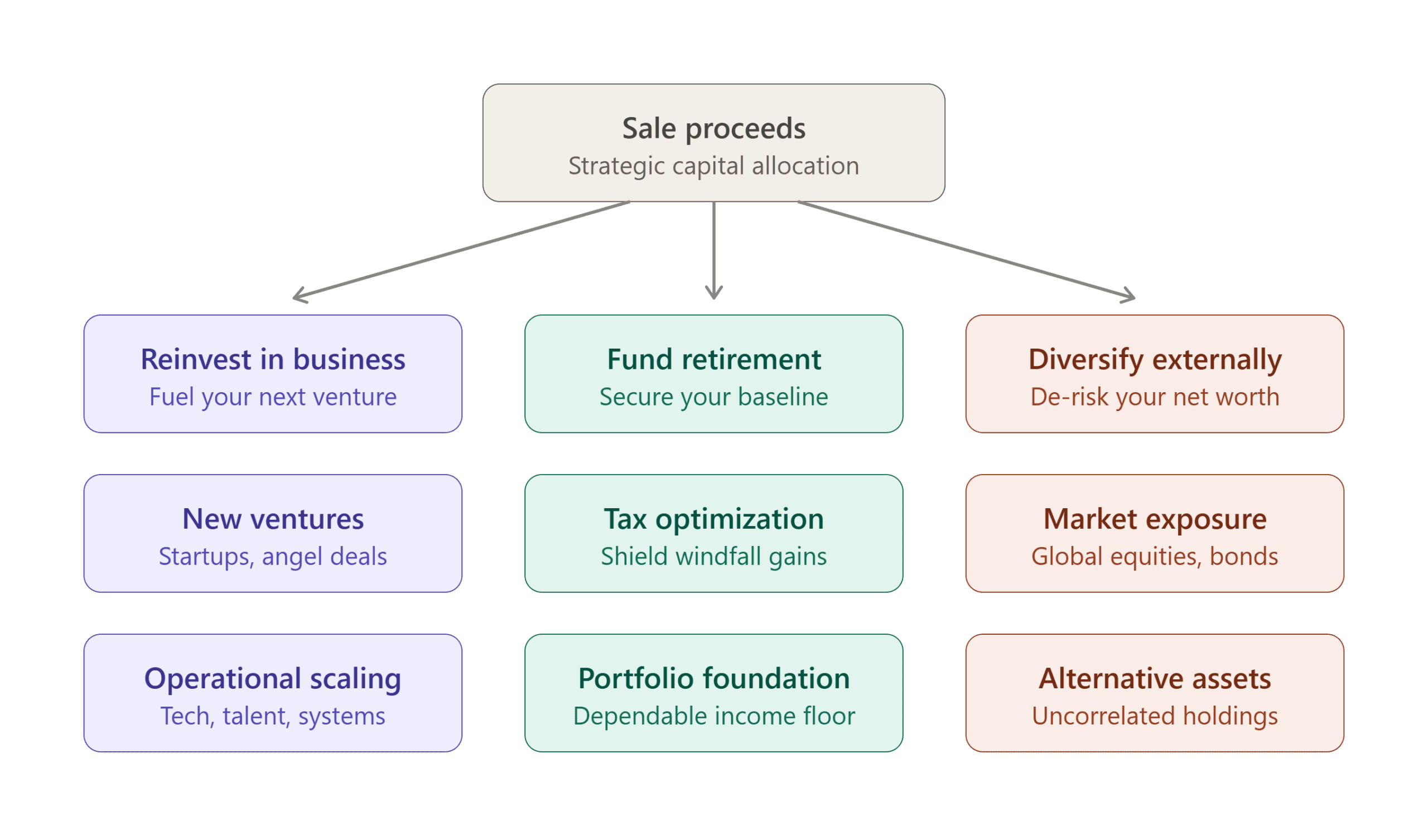
- Reinvestment vs. diversification – Decide how much capital to put back into the business versus allocate to external investments. This ratio should shift as your business matures and your personal financial goals evolve.
- Retirement accounts – SEP IRAs, SIMPLE IRAs and 401(k) plans aren’t just employee benefits — they’re powerful tax-advantaged tools for owners. A solo 401(k) can allow much higher contribution limits than a standard IRA, making it one of the most effective wealth-building vehicles for self-employed individuals.
- Private market opportunities – Depending on your situation, private equity, private credit or other alternative investments may complement your public market portfolio. These investments should be evaluated against your overall investment and retirement planning strategy.
- Investment risk assessment – Every investment decision should be weighed against your existing concentration risk. If the business is performing well but consuming most of your attention, your personal portfolio may need to be more conservative to balance overall exposure.
Where should your money go?
Financial Forecasting and Analysis Techniques
If budgeting tells you where you are, forecasting tells you where you’re going. Financial forecasting uses historical data and current trends to project future revenue, expenses and cash flow so that you can make decisions based on evidence rather than instinct.
For startups and growing businesses, forecasting is especially valuable because it helps you anticipate problems before they happen. Running out of cash is rarely a surprise if you’re watching the right numbers closely enough.
Core forecasting horizons:
- Short-term (1-3 months) – Cash flow projections to manage liquidity and meet obligations
- Mid-term (6-12 months) – Revenue and expense forecasting to guide hiring and investment decisions
- Long-term (3-5 years) – Strategic planning projections tied to growth goals, exit timelines or capital raises
The table below shares five financial metrics worth tracking regularly.
| Metric | What It Tells You |
|---|---|
| Gross profit margin | How efficiently you’re producing your product or service |
| Operating cash flow | Whether day-to-day operations generate real cash |
| Current ratio | Short-term liquidity — can you cover near-term obligations? |
| Debt-to-equity ratio | Financial leverage and overall risk level |
| Net profit margin | Overall profitability after all expenses |
The best forecasting isn’t just about building a model. It’s about reviewing that model regularly against actual results then adjusting strategy accordingly.
Choosing the Right Financial Management Apps
Technology has made financial management dramatically more accessible for small business owners. The right tools can automate bookkeeping, generate real-time reports, track invoices and connect your business finances directly to your tax filing, saving time and reducing costly errors.
What to look for in financial management software:
- Ease of use for non-accountants
- Integration with your bank accounts, payroll and payment platforms
- Real-time reporting and dashboard visibility
- Tax preparation support or direct CPA integration
- Scalability as your business grows
One important caveat: software is a tool, not a strategy. It can organize your financial data, but it can’t interpret it, identify opportunities or help you make decisions. The best approach combines good software with qualified professionals who can add the context and judgment that technology can’t replicate.
Retirement Planning for Business Owners
Here’s a reality that catches many business owners off guard: the business isn’t your retirement plan. Or at least, it shouldn’t be the only one.
Relying entirely on a future business sale to fund retirement is a high-risk strategy. Valuations change. Sales fall through. Markets shift. The time between when you want to exit and when you actually can may be longer than expected — and the proceeds may be different than planned.
That’s why building retirement assets outside the business matters, even when the business is doing well.
Retirement account options for business owners include:
- SEP IRA – This account type is simple to set up, allows contributions up to 25% of compensation (up to IRS limits) and is great for sole proprietors and small teams.
- SIMPLE IRA – This account type is designed for businesses with fewer than 100 employees and has lower contribution limits but easier administration.
- Solo 401(k) – This account type is for self-employed individuals with no full-time employees and allows both employee and employer contributions for higher overall annual limits.
- Traditional 401(k) with profit sharing – This account type is for larger businesses. It’s highly flexible and can include employer matching.
Choosing the right plan depends on your business structure, number of employees, income level and tax situation. The financial planning tips for entrepreneurs that Creative Planning’s advisors recommend also include implementing a personal estate plan. How your retirement assets are structured affects how they’re taxed, how they pass to heirs and how they interact with your eventual business exit.
Exit Planning: Possibly Your Biggest Financial Decision
At some point, every business owner exits. Whether via a sale, a transfer to family, a management buyout or something else entirely, how you prepare for this moment determines how much wealth you actually walk away with.
Most business owners wait too long to start thinking about their exit. Exit planning should ideally begin years — sometimes even a decade — before you actually want to leave. Small decisions made during this window can significantly increase your business’s value and the after-tax proceeds you keep.
Key areas to address well before an exit include:
- Business valuation – Work with a professional to understand what your business is worth today — and what drives the valuation. This informs everything from buy-sell agreements to gift strategies.
- Tax strategy – Deal structure, installment sales and charitable strategies can all affect your after-tax outcome dramatically. These aren’t decisions to make when a buyer is at the table.
- Personal financial readiness – Clarify how much after-tax wealth you need to sustain your lifestyle and meet your goals post-exit. Your financial plan should answer this question before an offer arrives.
- Succession planning – Whether you’re selling to a third party or transferring to family or employees, a detailed business owner’s financial checklist is an essential starting point for organizing what needs to happen before a transition.
The difference between a well-timed, well-structured exit and a reactive one can be substantial — both financially and personally.
Resources for Continuing Your Financial Education
You don’t have to be a financial expert to make great financial decisions — but knowing enough to ask the right questions and recognize good advice is essential. Below are a few resources worth bookmarking.
Online learning
- Coursera and edX offer free and paid courses on financial management and entrepreneurial finance through universities like Wharton and MIT.
- The SBA Learning Center offers free courses covering business finances and planning basics.
- LinkedIn Learning has practical courses on QuickBooks, financial modeling and small business management.
Reading
- “Profit First” by Mike Michalowicz shares a practical approach to cash flow management for small businesses.
- “Simple Numbers, Straight Talk, Big Profits” by Greg Crabtree offers a guide to financial clarity for entrepreneurs.
Professional resources
- A CERTIFIED FINANCIAL PLANNER® professional with business owner expertise can help coordinate your business and personal financial strategies, from retirement and investment planning to succession and estate considerations.
- A CPA who specializes in small business tax strategy can help you navigate tax obligations, identify planning opportunities and evaluate the tax implications of business and personal financial decisions.
Next Steps: Putting It All Together
Good financial planning isn’t a one-time event — it’s an ongoing process. The business changes. Tax laws change. Your personal goals evolve. Your plan needs to keep up.
Here’s a practical to-do list to help you get started:
- Separate your business and personal finances completely (if you haven’t already).
- Build or update your budget, and commit to reviewing it monthly.
- Create a 90-day cash flow projection.
- Evaluate your insurance coverage (both business and personal).
- Open or maximize a retirement account outside the business.
- Schedule a conversation with a financial advisor who specializes in business owner planning.
The foundation of long-term wealth for business owners isn’t just hard work — it’s integrated, intentional financial planning that’s started early and revisited often.
