



Key Takeaways
- Audit readiness is an ongoing process, not a once-a-year fire drill.
- Strong documentation, internal controls and clear timelines drive a smooth, successful audit.
- Reviewing prior audit findings and addressing documentation gaps improves future engagements.
- Continuous audit preparedness supports better compliance, financial reporting and stakeholder confidence.
- Treating the financial statement audit as a year-round priority can reduce stress and improve operational efficiency.
Think Beyond Year-End Preparation
An audit should never be viewed as a once-a-year event. Successful audits are the result of consistent audit preparedness throughout the year, not a last-minute rush to close the books. Organizations that maintain current reconciliations, keep supporting documentation organized and communicate regularly with their external auditors often experience a smoother audit process with fewer surprises, delays or extra costs.
Establishing clear expectations, dedicating adequate staff time and designating a primary point of contact for the audit team can significantly reduce stress and improve efficiency. When your finance team understands audit requirements, has access to needed financial records and can quickly respond to auditor questions, you’re far more likely to achieve continuous audit readiness instead of scrambling at year-end.
Understand the Audit Process
The audit process typically begins with planning, where auditors develop an understanding of the organization, its operations and key financial statement areas. A strong audit plan works like a road map, defining what needs examination, identifying the riskiest areas and setting realistic timelines for fieldwork and reporting. It’s during the planning phase that auditors may also initiate confirmations with banks, donors or other third parties when necessary.
During fieldwork, auditors perform detailed testing of transactions, account balances and internal controls to evaluate whether your financial reporting is accurate and compliant with accounting standards and regulatory requirements. The final stage involves resolving outstanding items, drafting the audit report, communicating results to management and governance committees, and issuing the audited financial statements. For many organizations, understanding this full audit process is easier when they’ve already learned the differences between an audit, a review and a compilation.
Develop a Timeline and Assign Responsibilities
One of the most important ways to improve audit efficiency is to develop a detailed timeline and assign responsibilities well in advance. Organizations should review the auditor’s request list early, identify any complex items requiring additional attention, and assign specific tasks to team members based on their expertise and availability. A clear audit preparation timeline may include milestones for completing year-end adjustments, reconciling accounts, gathering supporting documentation and conducting internal reviews.
Providing completed schedules and supporting documentation before fieldwork begins allows auditors to start their work more efficiently and reduces the number of follow-up requests. A proactive approach helps ensure deadlines are met and prevents last-minute scrambling. When everyone on the finance team understands their role in the audit process, audit readiness becomes part of your internal processes rather than an extra project.
For some owners, planning for a future transaction — such as strategic exit planning for business owners and founders — can also drive a more disciplined approach to audit preparation, because prospective buyers and investors often review financial statement audits as part of their due diligence.
Nonprofit organizations preparing for future grant opportunities should also be audit-ready. Foundations, government agencies and other major funders often review audited financial statements, internal controls and financial management practices when evaluating an organization’s readiness to manage significant awards.
Stay Current and Learn From Prior Audits
Organizations should stay informed about new accounting standards, regulatory requirements and compliance audits that may affect financial reporting and audit requirements. Regular discussions with your external auditor throughout the year can help management understand upcoming changes and avoid surprises during the audit, particularly around evolving standards or industry-specific compliance expectations.
In addition, reviewing prior audit findings, last year’s audit adjustments, internal control recommendations and areas that caused delays can help the organization strengthen processes and improve audit readiness. Every audit experience provides valuable lessons that can improve future engagements. When you document action plans, assign owners and follow through on remediation, you transform previous audit findings into practical improvements in risk management and accountability.
Prior audit findings: questions to ask
- Were all prior audit findings fully resolved, and is there documentation showing they were addressed?
- Have related internal controls been updated to reduce the likelihood of the same issue happening again?
- Were corrective actions assigned to specific owners, and were those items completed on time?
- Did any delays, repeat requests or documentation gaps from the prior audit carry over into the current year?
- Are there policy, process or training changes that should be made based on the previous audit experience?
Build Continuous Audit Readiness Into Your Processes
Audit readiness is strongest when it’s embedded into day-to-day workflows rather than treated as a once-a-year clean-up. Continuous audit readiness means having reconciled accounts, organized documentation and updated internal controls that can support an audit at almost any time. In practice, this often includes monthly or quarterly reconciliations of key accounts, routine documentation reviews and periodic internal control testing.
Creative Planning Advisor Insight
“Audit readiness isn’t about passing a single test once a year. It’s about building everyday habits — in documentation, controls and communication — so that your organization is always prepared when auditors arrive.” – Brian Aronson, Director
By treating month-end close as a rehearsal for the annual financial statement audit, your team can identify documentation gaps, unusual entries and process issues long before auditors arrive. This ongoing attention supports better risk assessment, strengthens compliance efforts and reduces the likelihood of last-minute surprises that can extend fieldwork and increase costs. Business owners who are thinking about future transitions often find that continuous audit readiness provides cleaner numbers and clearer trends for potential buyers.
Organize Financial Information Throughout the Year
Strong organization of financial information is a key factor in a successful audit. Creating a centralized repository for audit support schedules and organizing files by major financial statement areas — such as cash, receivables, payables, fixed assets, debt and revenue — can make information easier to locate and update each year. Many organizations benefit from checklists or mock audit exercises to confirm that financial records and documentation are complete and accessible before fieldwork begins.
Common audit requests often include trial balances, bank reconciliations, accounts receivable and payable listings, payroll records, prepaid expense schedules and documentation supporting significant accounting policies and transactions. Maintaining these items throughout the year reduces preparation time and improves accuracy while also making it easier to demonstrate compliance with regulatory requirements and industry standards if questions arise.
| Document type | What Auditors Typically Look For | Why It Matters |
|---|---|---|
| Bank reconciliations | Reconciliations for all bank accounts, along with supporting statements and outstanding items | Helps confirm cash balances are accurate and complete |
| Trial balance | A final trial balance that ties to the general ledger and draft financial statements | Gives auditors a starting point for testing account balances and financial reporting |
| Accounts receivable listings | Detailed aging reports, customer balances and support for significant receivables | Helps auditors evaluate collectability, accuracy and proper revenue recognition |
| Accounts payable listings | Vendor balances, unpaid invoices and accrued expense support | Supports testing of liabilities and whether expenses are recorded in the correct period |
| Payroll records | Payroll registers, tax filings, benefit reports and employee compensation support | Allows auditors to test payroll expense, withholdings and related compliance requirements |
| Prepaid expense schedules | Detailed schedules showing beginning balances, additions, amortization and ending balances | Helps confirm expenses are recognized in the appropriate reporting periods |
| Fixed asset schedules | Asset listings, depreciation schedules, additions, disposals and related invoices | Supports testing for existence, valuation and depreciation accuracy |
| Debt agreements | Loan documents, amortization schedules and lender confirmations when needed | Helps verify balances, terms, covenant requirements and related disclosures |
| Revenue support | Contracts, invoices, donor records or other support for significant revenue transactions | Helps auditors evaluate whether revenue is complete, accurate and properly reported |
| Accounting policies and significant transactions | Documentation for key accounting policies, unusual transactions and management judgments | Gives auditors context for complex areas and supports compliance with accounting standards |
Strengthen Internal Controls and Documentation
A well-prepared audit depends on strong internal controls and clear documentation. Documenting internal controls — including approval workflows, segregation of duties and key financial reporting checks — gives auditors evidence that your organization actively manages risk. Regular control testing and documentation of results help show that these controls operate effectively over time.
A simple way to think about this process is as a connected sequence:
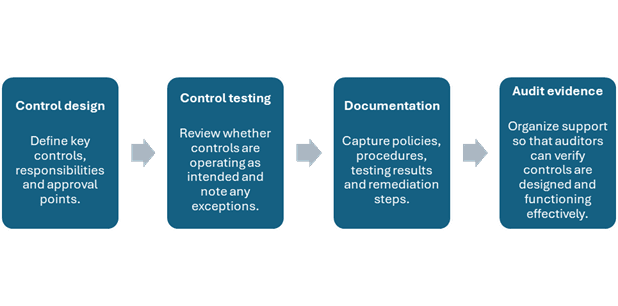
If you’re unsure where to start, Creative Planning’s How Strong Are Your Business’s Internal Controls? can be a helpful resource for thinking through potential gaps in your control environment and opportunities to improve. Documentation is the backbone of audit readiness. It includes financial records, policies, procedures, and evidence of compliance activities that support your financial statements and demonstrate adherence to audit requirements. When internal control documentation, policy manuals and process descriptions are up to date and easy to access, auditors can more quickly understand how your systems work and verify that controls are designed and operating effectively.
Perform a Final Review and Evaluate Results
Before fieldwork begins, organizations should perform a thorough self-review. Financial schedules should reconcile to the general ledger, unusual fluctuations should be investigated and draft financial statements should be evaluated for overall reasonableness. Some organizations conduct a mock audit or internal review to simulate auditor questions, identify documentation gaps and confirm that all reconciliations are complete.
After fieldwork is complete, management should continue communicating with auditors regarding any outstanding items and hold a post-audit debrief with staff to discuss lessons learned. Reviewing audit findings, timing challenges and documentation gaps gives you a chance to refine processes and improve operational efficiency. A little preparation on the front end can save significant time on the back end, making future audits more efficient and more valuable for the organization.
Post-audit debrief checklist
- What worked well during this year’s audit process, and what should be repeated next time?
- Where did delays occur, and were they caused by timing, staffing, reconciliations or documentation gaps?
- Were any control weaknesses, process breakdowns or repeat findings identified during the audit?
- Do policies, procedures or staff training need to be updated based on auditor feedback?
- What corrective actions should be tracked between now and the next audit cycle?
Treat Audit Readiness as a Strategic Advantage
A well-prepared audit is more than a compliance exercise — it’s an opportunity to strengthen financial processes, improve internal controls and enhance confidence among stakeholders. Organizations that invest time in planning, maintaining organized financial records, communicating with auditors throughout the year and learning from prior audit experiences are typically rewarded with a more efficient and productive engagement.
By treating audit readiness as a continuous process rather than a year-end project, organizations can reduce stress, minimize disruptions to daily operations and maximize the value received from the audit. Over time, this culture of audit preparedness supports stronger governance, more reliable financial reporting and a clearer picture of the organization’s overall health and risk profile.
If you’re looking for support in building year-round audit readiness, Creative Planning’s business services team can help you evaluate your current processes, strengthen internal controls and organize documentation ahead of your next engagement.
