



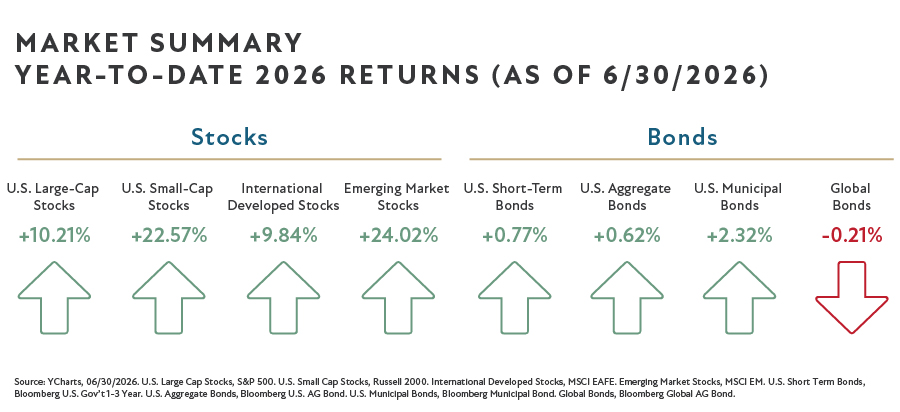
This image shows year-to-date 2026 returns as of 6/30/2026. U.S. large-cap stocks are up 10.21%. U.S. small-cap stocks are up 22.57%. International developed stocks are up 9.84%. Emerging market stocks are up 24.02%. U.S. short-term bonds are up 0.77%. U.S. aggregate bonds are up 0.62%. U.S. municipal bonds are up 2.32%. Global bonds are down 0.21%.
With the ultimate tongue twister, the semiquincentennial of Independence Day, upon us, markets continue their ascent, with stocks and bonds both having climbed higher year-to-date.
While bonds have primarily maintained positive returns, after factoring in the impact of inflation — which has remained elevated — real returns are flat to slightly negative. Yet stocks have mostly seen healthy double-digit returns, with asset classes that underperformed over the last decade, like small cap stocks and emerging market stocks, seeing increases of more than 20%. This is a healthy reminder of the benefits of broad diversification.
However, positive returns across nearly all asset classes can’t mask the abundance of market and global uncertainties currently facing the economy (such as the unknown impacts of artificial intelligence, the largest oil shock in history and the specter of higher interest rates, to name a few). As we head into the Fourth of July, it’s worth remembering that the Founding Fathers were making decisions in an environment with extreme uncertainty as well.
They didn’t know how the revolution would end.
They didn’t know what the economy would look like.
They didn’t know whether their experiment in self-governance would succeed.
The Founding Fathers didn’t have clarity — they had conviction in a system: a set of principles designed to withstand uncertainty, not eliminate it. Investors face the same reality today.
The future is uncertain, and it always has been. The difference is that we often convince ourselves that this uncertainty is new or uniquely elevated. It isn’t.
The question isn’t “what happens next?” It’s “what process holds up regardless of what happens next?”
Below are a few timely — and timeless — market lessons pulling in some familiar faces.
George Washington: Avoid Kingmaking
After the Revolutionary War ended, there were serious discussions about making George Washington a king. When he refused, the Continental Congress believed his title should be “His Highness, the President of the United States and Protector of the Rights of the Same.” He refused again and settled for President of the United States.
The idea of concentrating power in a single individual was viewed as too risky — too much would depend on one person, one decision, one outcome.
The IPO buzz of today is the same as kingmaking. The recent SpaceX IPO has created an excitement we haven’t seen since the last rash of tech IPOs nearly 25 years ago (think Google and an entire host of now bankrupt internet startups),1 and the IPOs of AI titans Anthropic and OpenAI are likely to follow suit.
IPOs are just another dirty little secret that Wall Street has miraculously gotten away with for far too long. As graphed, the average IPO is down 31% one year after its first close! The founding father of the American circus, P.T. Barnum, would blush with envy at Wall Street’s ability to sell this lie again and again and again.
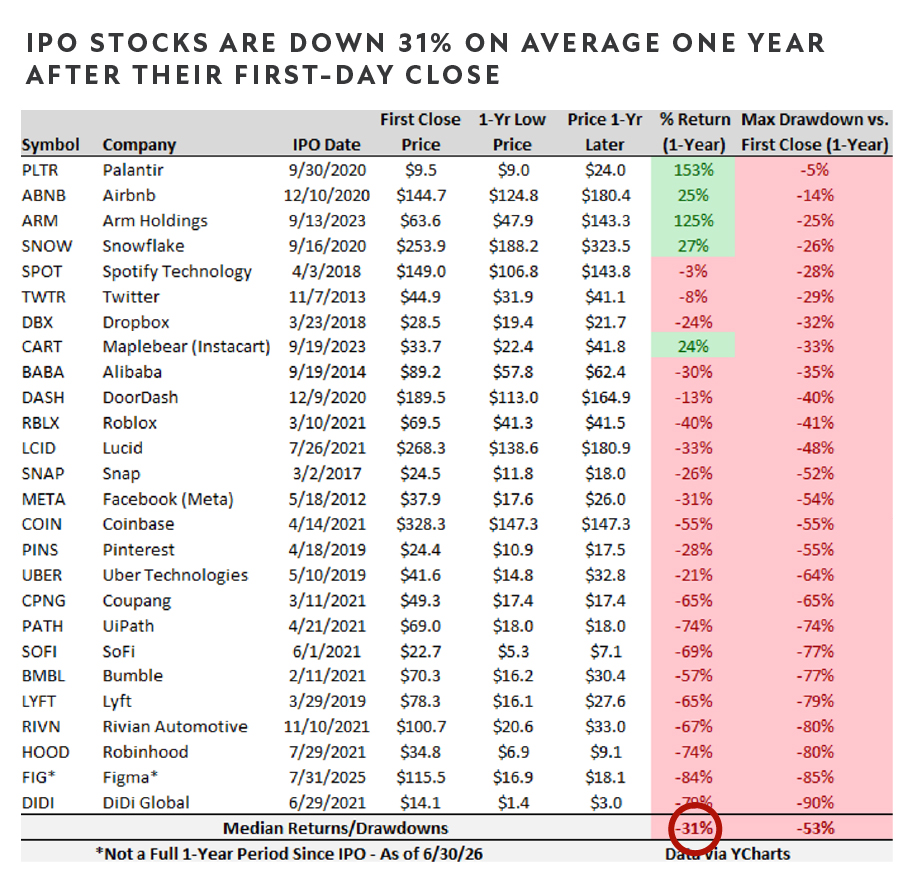
This table shows 26 major IPOs from the last 15 years along with their IPO date, first close price, one-year low price, price one year later, one-year return and max drawdown vs. first close. One year after their first-day close, the stocks are down 31%, on average (with only five of the 26 stocks positive).
Zooming out, the same thing can be said about concentration in just a few names. Five of the seven so-called Magnificent 7 (Mag 7) are getting trounced by the S&P 500 over the trailing two years.
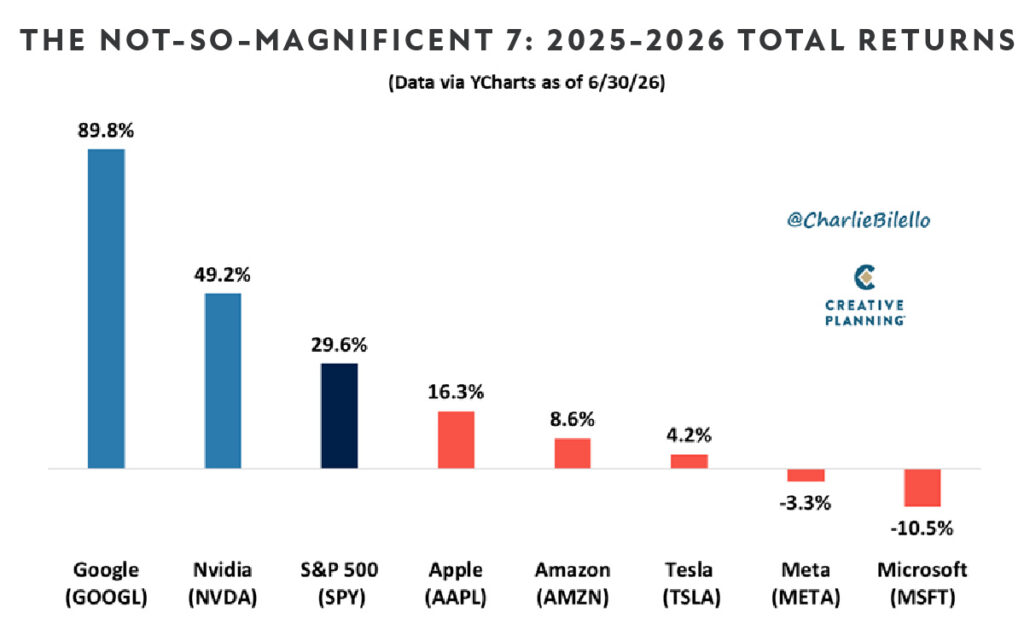
This chart shows the performance of “Magnificent 7” stocks, Google (89.8%), Nvidia (49.2%), Apple (16.3%), Amazon (8.6%), Tesla (4.2%), Meta (-3.3%) and Microsoft (-10.5%), and how they performed relative to the S&P 500 overall (29.6%).
Zooming out even further, the trouncing of the Mag 7 is even more pronounced compared to other market segments, like small cap, emerging market and value stocks. Many of these asset classes have underperformed for years, but a reversion to the mean always manifests itself over time. Should investors go running to these different asset classes now? Absolutely not — just like one shouldn’t have run from them while they underperformed. They all serve a purpose in a well-diversified portfolio.
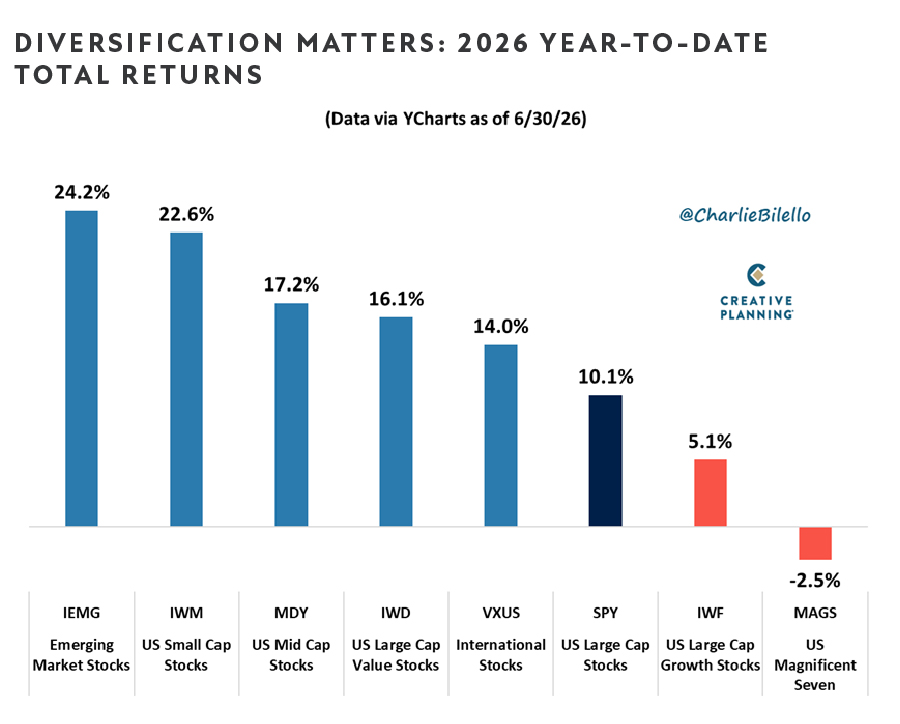
This chart shows 2026 year-to-date returns for emerging market stocks (24.2%), U.S. small cap stocks (22.6%), U.S. mid cap stocks (17.2%), U.S. large cap value stocks (16.1%), international stocks (14%), U.S. large cap stocks (10.1%), U.S. large cap growth stocks (5.1%) and U.S. magnificent 7 stocks (-2.5%).
John Adams: Do the Right Thing, Even When It’s Extraordinarily Unpopular
John Adams provides a different, but equally important, lesson.
He made several decisions that were deeply unpopular during his presidency, including avoiding a broader conflict with France that our young republic was too fragile to handle.
He prioritized long-term stability over short-term approval — a choice that likely cost him politically but proved beneficial over time.
Investors face a similar challenge. The pressure to react to markets, headlines and uncertainty can be constant. But the evidence consistently shows that disciplined, long-term decisions tend to outperform reactive ones. The stock market has averaged annualized returns of nearly 10% over the last 100 years. As graphed, there will be entire decades, like the 1930s or 2000s, where returns will be nothing — or even violently lower. But this is the price of admission for the fact that you’re always rewarded over the long run more for being an owner versus being a lender. Bonds have had a horrible decade, making the disparity even more pronounced, but they’ll always underperform over the long run.
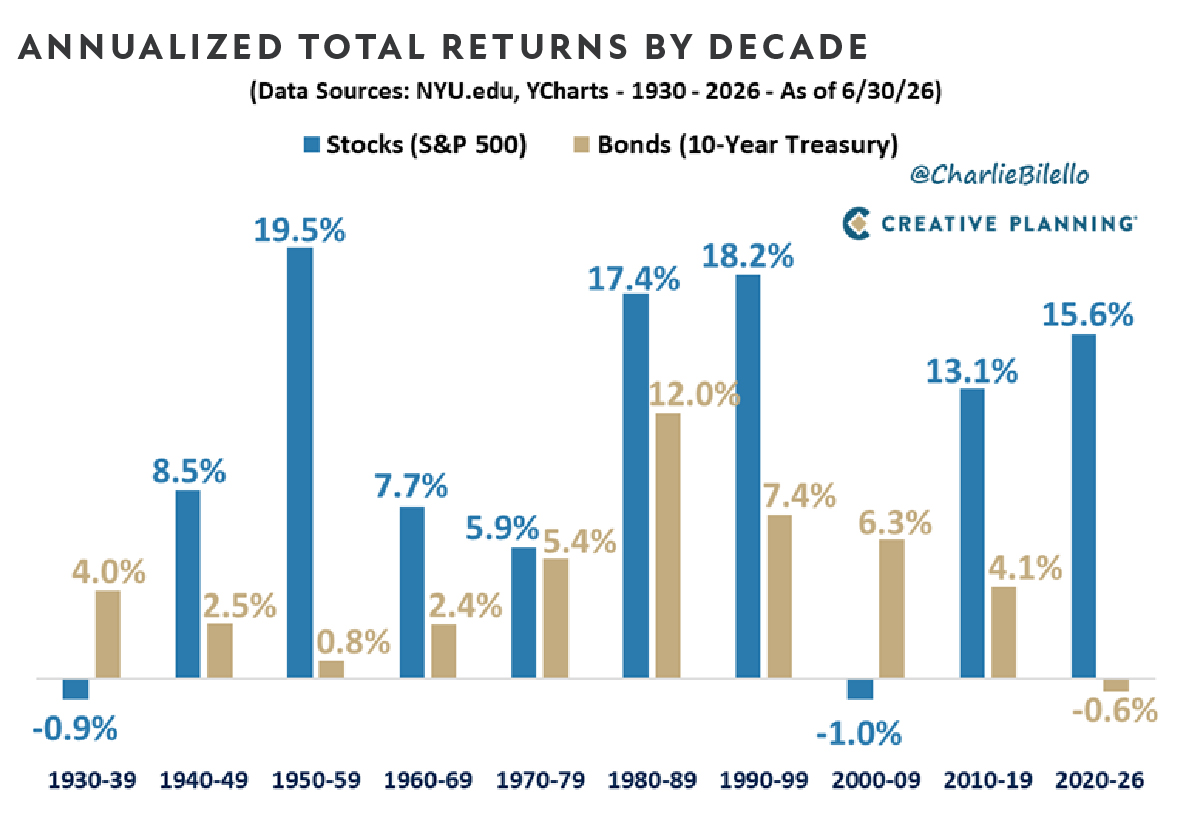
This chart shows annualized total returns by decade for both the S&P 500 and 10-year Treasury bonds. For the S&P 500, 1930-39 is -0.9%, 1940-49 is 8.5%, 1950-59 is 19.5%, 1960-69 is 7.7%, 1970-79 is 5.9%, 1980-89 is 17.4%, 1990-99 is 18.2%, 2000-09 is -1.0%, 2010-19 is 13.1% and 2020-26 is 15.6%. For 10-year Treasury bonds, 1930-39 is 4.0%, 1940-49 is 2.5%, 1950-59 is 0.8%, 1960-69 is 2.4%, 1970-79 is 5.4%, 1980-89 is 12.0%, 1990-99 is 7.4%, 2000-09 is 6.3%, 2010-19 is 4.1% and 2020-26 is -0.6%.
A more widespread, and unfortunately even more punishing, lie Wall Street has propagated is that the average retiree or near retiree should have a majority of their portfolio in bonds. The allocation to bonds should be no more than what’s required to fund your short- and intermediate-term withdrawal needs (ideally five to seven years’ worth), thus allowing you to completely disregard short-term market movements and keep living the exact same life you have planned out. This bond cushion gives the more aggressive elements of your portfolio, which will appreciate more over the long term, time to recover from shorter-term inevitable downturns. While especially unpopular and most often discarded during these periods of heightened volatility, this is always the right course to chart.
Benjamin Franklin: Be Prepared for a Range of Possible Outcomes
Benjamin Franklin approached uncertainty from yet another angle. He understood that outcomes couldn’t be predicted with precision, so he focused on preparation, creating flexibility and positioning for a range of possibilities rather than a single expected outcome.
Wall Street was again convinced entering 2026 that interest rates would go down. However, things didn’t end up charting out as they’d planned, and not only have rates failed to decline but the Federal Reserve may actually move rates higher at their next meeting.
Strength isn’t found in clairvoyant crystal ball-type powers but rather in responding appropriately as market conditions present themselves.
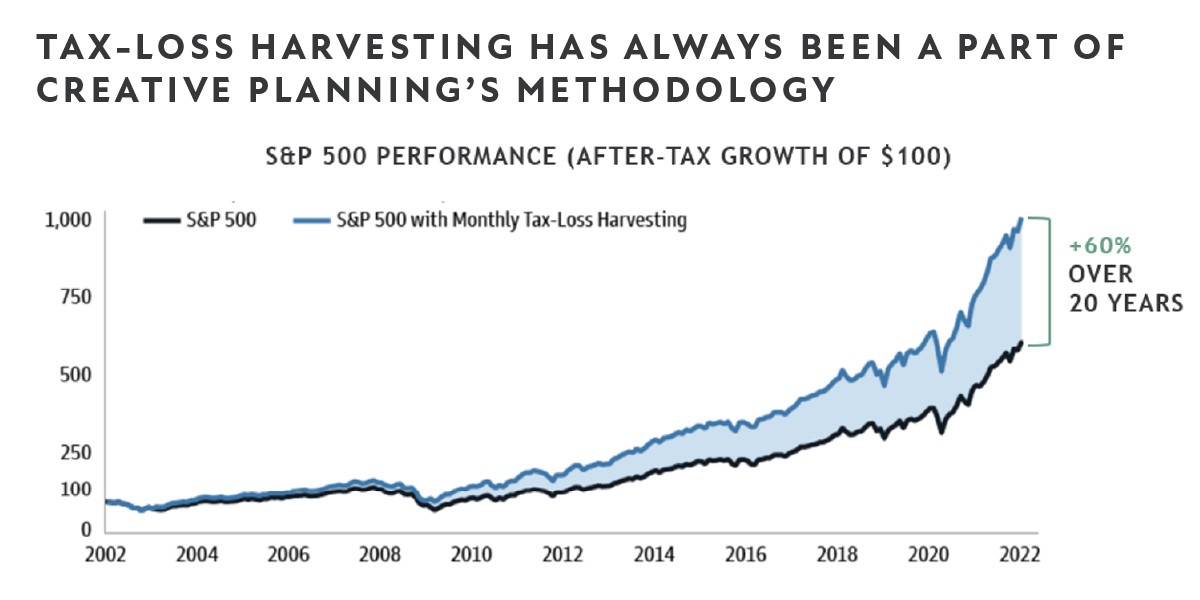
As graphed below, for taxable dollars, the compounding benefit of regular tax-loss harvesting versus standard investing can be extraordinary. Nothing more is required beyond investing in the same thing — just more tax efficiently. The same holds true for 401(k)-type investing. Make sure every free penny offered to you (and your larger family) by your employer is accepted. Contribute in the right manner (Roth vs. traditional) based on what your current tax circumstances dictate. Fund the kids’ (and grandkids’) education accounts. Planning properly across the comprehensive grid of your financial circumstances has the power to generate amazing long-term benefits.
Source: Bloomberg and Goldman Sachs Asset Management
This chart shows the after-tax growth of $100 invested in the S&P 500 in 2002 over 20 years, both with and without tax-loss harvesting. Tax-loss harvesting adds more than 60% in gains over 20 years.
The Founding Fathers didn’t try to predict the next battle — they built a system that could endure many of them. Investors must think the same way.
The future remains uncertain. The process doesn’t.
Have a safe and prosperous 250th Independence Day — and enjoy the progress that disciplined systems can create over time.
Author’s Note:
The most remarkable series of American letters to exist is that between John Adams and Thomas Jefferson. Extremely close friends and working partners during the American Revolution, their relationship soured after a bitter election campaign that saw Jefferson replace Adams as president. Decades passed before their friendship resumed, lasting the remainder of their long lives, which both ended within hours of each other on July 4, 1826, exactly 50 years after the signing of the Declaration of Independence. Time is the only currency you spend without knowing your balance. Use it wisely. If there is a Jefferson to your Adams out there, go ahead and reach out. They, and you, will be glad you did.
