



Investors often hear that rising interest rates are bad for stocks and that falling rates are good. Nearly a century of market data tells a more nuanced story.
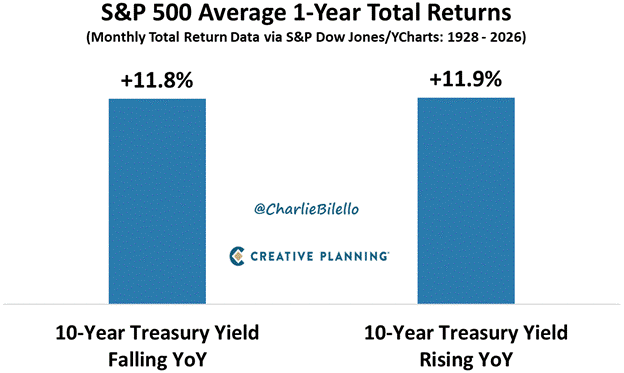
In this highlight from The Week in Charts, Creative Planning Chief Market Strategist Charlie Bilello compares average one-year S&P 500 total returns in periods when the 10-year Treasury yield was rising year over year with periods when it was falling. The two averages were nearly identical.
Source: Charlie Bilello. Monthly total return data via S&P Dow Jones Indices/YCharts, 1928–2026.
What the Chart Shows
From 1928 through 2026, the S&P 500’s average one-year total return was:
- 11.8% in periods when the 10-year Treasury yield was falling year over year.
- 11.9% in periods when the 10-year Treasury yield was rising year over year.
A difference of 0.1 percentage point doesn’t support the idea that rising yields automatically translate into weaker stock returns, or that falling yields reliably produce stronger ones.
These figures are historical averages, not a result for any single year and not a forecast. They also don’t show that interest rates have no effect on stocks. What they do show is that the direction of yields, by itself, tells an incomplete story.
Charlie’s Insight
“It’s not that it doesn’t matter if interest rates are rising or falling, but you have to know why they’re rising and falling … to say whether it’s going to be ultimately good or bad for the stock market.”
— Charlie Bilello, Chief Market Strategist
The Reasons Behind Yield Changes Matter
To interpret a move in Treasury yields, investors need to understand why yields are rising or falling.
Rising yields may reflect stronger economic growth and expectations for higher corporate earnings, which can be a favorable backdrop for stocks. They may instead reflect higher inflation expectations, which can be a less favorable one.
Falling yields carry the same ambiguity. They may reflect moderating inflation, including periods when the Federal Reserve is lowering its policy rate because inflation is easing. They may also signal concern about economic weakness or a coming recession.
In other words, the same movement in yields can accompany very different economic conditions. It’s also worth being precise about what this chart measures: year-over-year changes in the 10-year Treasury yield, not changes in the Fed’s policy rate. The two are not interchangeable.
When Higher Yields Become a Concern
Higher yields become a concern for stock investors when they start to create problems for corporations, such as higher borrowing costs that pressure the bottom line.
One way to gauge whether that is happening is to watch credit spreads, the difference between corporate bond yields and Treasury yields, for signs that borrowing conditions are becoming a problem for businesses. The question isn’t simply whether rates are higher, but what those higher rates mean for business conditions and profitability.
The Takeaway for Investors
The chart doesn’t support a simple “rates up, stocks down” rule. Historically, average S&P 500 total returns were nearly the same whether the 10-year Treasury yield was rising or falling year over year.
Rather than relying on the direction of interest rates alone, investors should consider the forces behind the move, including economic growth, inflation expectations and corporate earnings.
For related perspectives, listen to Rate Hikes, Recessions and the Biggest Risk or read our Q3 2026 Market Commentary.
This article highlights one chart from The Week in Charts with Charlie Bilello. Watch the full episode for the complete discussion.
